A Major Ukulele Chord Chart: Visual Diagrams for Right- and Left-Handed Players
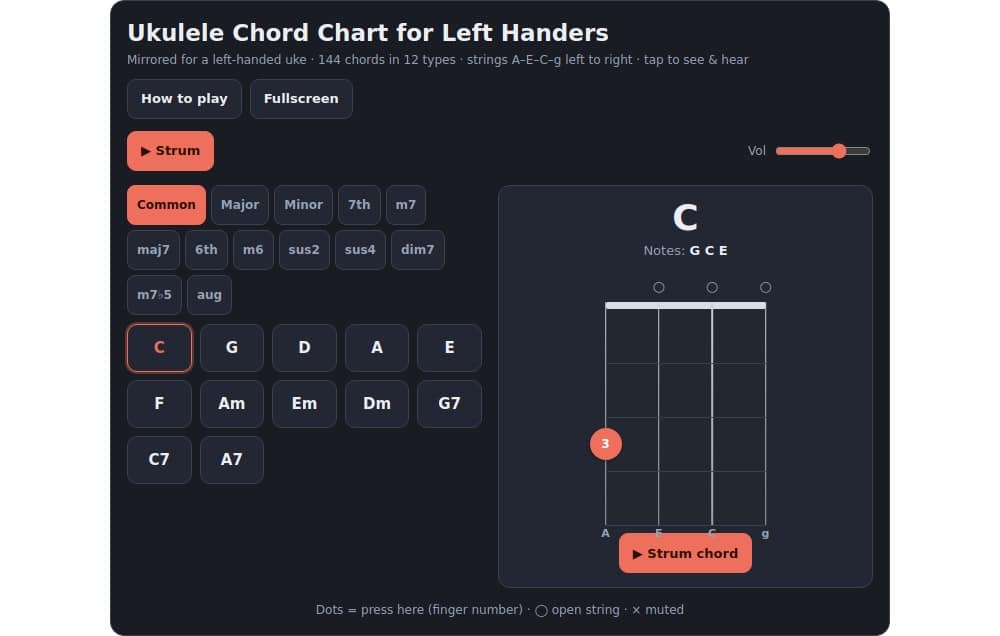
Understanding the internal mechanics of the A major chord on a four-string fretboard diagram turns rote memorization into functional knowledge. The A major triad consists of three distinct musical pitches: the root note (A), the major third (C#), and the perfect fifth (E). Because the ukulele possesses four strings, one of these pitches must double.
In standard tuning GCEA, string four (the top string closest to your chin) is tuned to G. Pressing the second fret raises that pitch by a whole step to an A. String three is tuned to C; fretting it at the first fret raises the pitch a half step to produce the critical C-sharp note first fret, giving the chord its bright, major tonality. The second string remains unfretted, sounding an open E. The first string (the bottom string closest to the floor) rings open as an A.
The resulting voicing produces pitches A-C#-E-A. Because the root note appears on both the outside edges of the instrument, striking a balanced downstroke provides an exceptionally bright, resonant ring. The primary mechanical pitfall occurs when the fleshy underside of the index finger grazes the open E string, dampening its vibration into an unappealing thud. Arching the knuckles into a strict perpendicular angle against the fingerboard resolves this issue immediately.