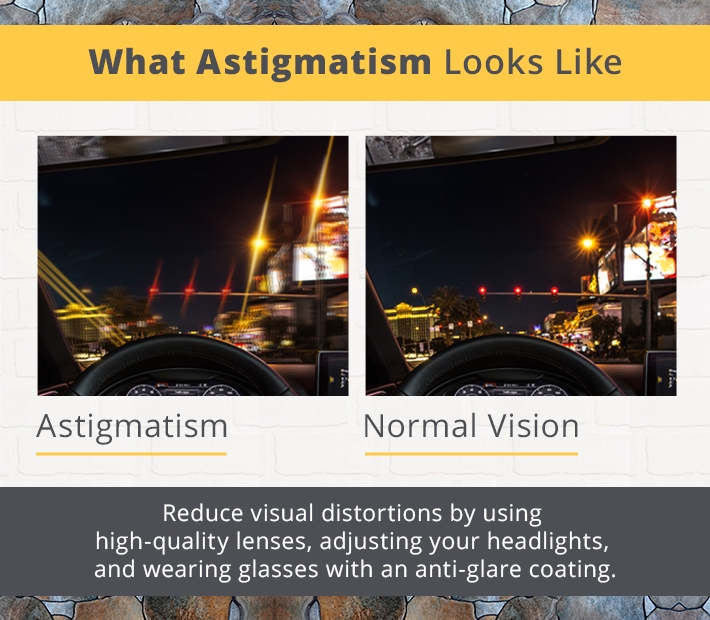
How to Drive Safely at Night with Astigmatism: Proven Solutions, Lens Coatings, and Habits
Q1: Why does astigmatism seem so much worse when driving at night compared to daytime?
A1: During daylight hours, bright conditions cause your pupils to constrict to roughly 2 to 3 millimeters, funneling light exclusively through the central portion of your cornea. At night, your pupils dilate up to 7 or 8 millimeters to gather available light. This expansion exposes incoming light rays to the steeper, irregular outer edges of your asymmetric cornea, scattering light into severe starbursts and halos.
Q2: Will over-the-counter anti-glare glasses work if I do not have a corrective prescription?
A2: No. Over-the-counter anti-glare glasses that lack an exact prescription will not correct the underlying corneal curvature error driving the distortion. If you have uncorrected astigmatism, even a mild cylinder error of -0.50 or -0.75 diopters, you require precise custom prescription eyeglasses treated with an authentic anti-reflective lens coating to achieve crisp focus.
Q3: Can laser eye surgery (LASIK or PRK) permanently fix night driving issues caused by astigmatism?
A3: Modern topography-guided and wavefront-optimized LASIK or PRK procedures can successfully reshape the cornea to correct astigmatism. However, during the initial 3 to 6 months following surgery, post-operative corneal swelling frequently causes temporary increases in halos and glare around headlights. Consult a refractive surgeon to verify whether your pupil size and corneal thickness make you a viable candidate.